Monday, June 11

Tablet vs e-Reader Owners

Now that the iPad has revolutionized the world of portable devices, what about the Kindle and Nook owners? What are tablet vs e-reader users doing on their digital device? A review of the evidence from several GfK MRI studies (US !), shared by Kathi Love, President and CEO of GfK MRI, on the last FIPP Research Forum.


A meteoric growth of portable digital devices 


Tablet and e-reader Ownership has increased like never seen before with 7.1 million iPads and some 11.7 million e-readers in circulation (January - April '11). e-Reader users tend to be more female. Tablet ownership is more gender-balanced. "Users of tablets are younger than e-reader users, whose age profile has grown old since they were released". Both kind of users are highly educated in comparison with the average US-population.

Click to enlarge pic

News Addicted vs Bookworm?


Book reading seems still more common than periodical reading. Both kind of owners have read a book on their device during the last 6 month. But tablet owners are more likely to read magazines (38%)  and newspapers (37%) than e-reader users (magazines: 18% ; newspapers: 12%).

Most digital devices are used daily. Compared to e-reader owners, tablet owners use their device slightly more on average weekdays than weekend days. 47% of tablet users share their device with (an) other family member(s). e-reader owners tend to be more the sole user of their device (69%).

Tablets make the difference when it comes to 'online' activities such as reading or sending an e-mail, social networking, play games,... e-readers seem to be dedicated to... reading books. Some 62% of tablet owners say they have 10 or more apps on their device but a limited amount is regularly used.

Click to enlarge pic

Of course, tablet owners prefer free apps. And yet, approximately 66% of the apps downloaded were free (last 30 days before analysis). Problem, knowing that 66% of the apps available in the Apple AppStore are not for free.

Are Digital Readers Confused?


Digital is convenient but tablet readers are still in love with printed magazine copies, praising the format and the ability to rip out any articles or ad that they find interesting. Kathi Love admitted that there is still some confusion over whether users prefer the digital version to the print one. Understandable, knowing that 65% of tablet readers say it's more satisfying to read a magazine in the traditional way while 67% declare that if available, they would prefer the electronic version.

When it comes to digital reading, 72% of tablet users want all magazines to be formatted in the same way. Nearly the same amount would like to be able to buy items by clicking on the magazine ad. In short: the benefits seem to be a richer experience with digital and a more tactile one with print - read on the FIPP website where you can find other informations about this review.

Source: GfK MRI iPanel, GfK MRI Survey of the American Consumer, GfK MRI Starch Digital 

Sunday, June 10

Asking the iPad User

During spring 2011, Publisher Axel Springer AG and market research agency Interrogare GmbH launched an iPad Panel dedicated to collect answers on editorial and advertising questions. Participants were (still are) recruited from the digital portfolio of Axel Springer. (More methodological information here)

Panelists must download a panel app to take part in (different) surveys. The 1.000 active respondents are regularly informed by the panel app via push-notification. One year after the launch, Anja Manouchehri, Market Research Specialist @ Axel Springer, has summarized the main benefits of a dedicated Panel App at the last FIPP Research Forum:

- survey on the iPad without media discontinuity for the panelists
- helps to establish an other kind of connection with the panelists
- leads to high response-rates (approx. 60-80%)
- 80% of the interviews are conducted within the first 3 days of field time

Impressive! But what about the survey results?

One out of two respondents carry their iPad (almost) everywhere. The tablet is  indispensable for 78% of the interviewees. 52% claimed that since they have the iPad, the overall consumption of printed media brands (as an app or printed) is higher than before. Even more interesting: 68% have read some newspapers or magazines - within an app - that they have never read before.

Click to enlarge pic

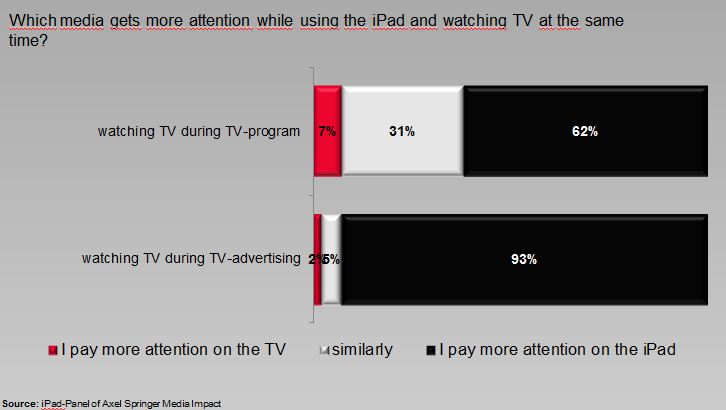
The tablet is also used while watching TV: 52% of the panelists often use their device during TV-advertising and 41% during TV-programs. Tablet users pay more attention to their gadget - even while watching a TV-program. A threat for TV-producers? Definitely, they have to transform this into an opportunity:

Click to enlarge pic

What's next? The Publisher has long-lasting plans with the iPad-Panel Media Impact:

- interviews will be enriched with technical measurements in apps
- the panel will be extended to Android users
- additional methods will be tested

It was interesting to have European research to 'confirm' findings from the US, for once. More findings and information {pdf}

Tuesday, June 5

Print - Enjoy the Journey

A spoken poem, in sound and picture, captivates the power of print. Released by InkGlobal in the United Kingdom The Journey is a must see. Enjoy the spoken poem; print is not dying. Produced by Ink, written and directed by David Bowden @ The Garden Studios. Spotted via @magazinespuntnl


Sunday, June 3

Taking Advantage of Editorial Credibility

During the FIPP Research Forum 2012, my Dutch colleague Ingrid van der Werf (Sanoma Media Netherlands) has shared interesting facts & figures on branded content in women's magazines. Thanks to recent quantitative and qualitative research (December 2011 - January 2012). There were three main purposes behind this initiative:
   - evaluate the effects of branded content on communication objectives
   - identify the conditions for effectiveness
   - determine criteria for successful branded content


She started with a definition that everyone can find on Wikipedia:
Branded content is a relatively new form of advertising medium (? euh) that blurs conventional distinctions between what constitutes advertising and what constitutes entertainment (true). Branded content is essentially a fusion of the two into one product intended to be distributed as entertainment content, albeit with a highly branded quality. 
And it works: advertorials in women's magazines are highly valued. According to readers, branded content "tells a different story than standard advertising" (quote qualitative research among 72 women aged 25-45). Therefore, it's not surprising that advertorials obtain a higher 'entertaining' score than classic ads (50% vs 36% - agree to: This page is made to entertain me - quantitative online research with dummy among 1200 women aged 25-45). 


When it comes to brand recall, advertorials obtain lower scores but that is compensate by higher scores for message recall: 44% for advertorials vs 33% for ads. The main objective(s) for using branded content in a nutshell: 
   - creating credibility
   - give more detailed product information
   - engaging readers


Challenge achieved for advertorials! As brand consideration scores are higher for branded content (50%) than for traditional ads (45%). Of course, both kind of advertising messages are mutually reinforcing each other. I'd like to end this summary by sharing 7 criteria for successful branded content in (women's) magazines:
    1. offer inspiration & tips
    2. give something to talk about
    3. complement editorial content (decode the codes of the magazine)
    4. be relevant (!)
    5. provide a fitting link with sender/brand (see point 3)
    6. be subtle about the benefits of the brand (readers know it's an ad)
    7. find a good balance between text and image


P.S.: Although branded content is not a new phenomenon in magazine advertising, the article on Wikipedia doesn't mention print at all! While there are great examples of successful advertorials in magazines. Print is definitely undervalued. But that was not the point of this blog post. However, if you want to know more about the do's and don'ts of branded pages in magazines, look at this great presentation with a lot of inspiration - by my colleagues at the Advertising Resource Centre (redirection on slideshare). 

Publishers' Reality Check and Call for Collaboration


Last Tuesday (29th May)  I went to London for my first  FIPP Research Forum (special thanks to my boss!). A two-day event for publishers, researchers and marketing executives in the magazine business. It's a huge opportunity to help improve magazine research around the world, to debate and compare learnings from each other's experience(s), to the benefit of all the industry. 

Unlike other conferences, the Research Forum encourages discussion and contributions from the floor with special sessions in breakout groups for delegate to debate the papers given in the previous session. Therefore, the number of delegates is set at a maximum of 50 in order to have restricted discussion groups with 12 to 14 delegates. Most of us agree this aspect of the Forum is/was the most valuable of the programme. 

The morning sessions of Day 2 (Wednesday) were dedicated to the digital and mobile developments in 'magazine land' with the focus on metrics and measurement techniques:

- The efficacy of Print + Web - Nicolas Cour (France)
- Consumers' use of talets, mobiles & other digital devices - Kathi Love (USA)
- Usage of and attitudes towards iPads: results from an iPad panel and How tablet in- advertising works - Anja Manouchehri (Germany)
- Measuring magazines' social media engagement, and building an overall engagement index John Carroll (UK)

When it was time to discuss these different studies in my breakout group, we looked at each other without enthusiasm. Because we felt there was more, an underlying question… Digital reading is (still) too small and publishers are losing feathers in the printed business model. The decline is not 'picked up' in digital reading. We have to face that we are becoming an industry in crisis. Without solutions in a short future, except trying new things and developments based (or not) on insights.  Don't get me wrong, we don't like short-termism but facts are facts. I can summarize our conversations in 3 key discussion points:

1. Do we really want the 'move' of our readers to digital? And more important: How do we 'keep' them in paper?

Duplication between print and digital is still very low. For magazines, it seems that digital is not (yet) the holy grail. We all agree it's necessary to create strong communities around our media brands. I have shared the example of the women weekly Libelle (Belgium) with a paid app dedicated to recipes called Libelle Lekker! together with the launch of a monthly about cooking with the same name. With some success.

My French colleague of Prisma Media, Nicolas Cour, cited the example of the TV guide Télé-Loisirs, that recently has launched an app - both on tablet and mobile - that makes it possible to program recordings with your device and out of home. Some services are paid and are satisfactory in term of profits. 

Egbert De Waal from South-Africa (Media 24) cited some nice examples of successfull cooking/fashion/specialized travel apps/mobile site with paid access to locally and 'internally' produced video content. 

But still, one big conclusion was: it's not enough to make profit, despite some successfull initiatives. In-app advertising and shopping can make a difference but we have not much understanding yet about this specific part of the business. It could mean an important charge for the short-term future in terms of development and the search of the right (commercial) partners.

2. To bundle or not to bundle? As magazine players tend to diversify in digital but also audiovisual media, it seems difficult to offer an advertising bundle that fits all the players of our industry.

To bundle or not to?
Are we sending the right signals to the market by acquiring other 'traditional' media active in the audiovisual sector or by investing a lot of money in digital companies and not in editorial? Where are these investments in print? 

Magazines are 'Pinteresting' avant la lettre, building strong readers' communities about specific AND general topics. We can show the market the engagement with traditional printed media is very high. But not seen as powerful enough. So, how can we convince readers and advertisers? 

Innovation is one key aspect. Flair Fashion Tag (Belgium) is a nice example: with this application readers can tag cloths and accessories in their Facebook friends’ photos. The tagged items are posted on the Fashion Tag wall and editors pick the best ones to publish in the magazine. Nice idea that improves the interactivity between the magazine brand and the readers and can result in commercial opportunities.


Finally, we ended this specific discussion topic with another important question: is bundling not dangerous in financial terms? Big (FMCG) companies are already claiming huge discounts when planning long-term campaigns. Is there a risk bundling will lead to discounts like never seen before? 

So, again the same conclusion: cross media strategies are not helping us at the moment. Soon, digital will become the next must-have in the media strategy together with TV. If the print industry don't act fast, it will lose the battle and will become 'nice to have but only when enough budget' for marketeers in charge of media strategies. 


3. Knowledge problem: digital people seem not interested in print. Therefore it's not a surprise they can't integrate print in a smart manner in the media plan.

People working in print and people in favor of printed media - dedicated planners and buyers in agencies included - seem to be better 'educated'. Digital players have little understanding of print in comparison to the digital knowledge of print players.


Conclusion:

So yes, we ended a little bit depressed. But not for long. Because we were able to face the truth and I'm sure it will lead to action and more collaboration. 

I would like to thank all the persons of breakout group B (see the list below) and Nancy Detrixhe in particular. Our dear chairman and reporter that has lent me her notes for this specific blog post. She's also doing a great job at the Dutch Publishers Association. Always posting new and relevant information about the power of print.


FIPP Research Forum 2012 - Breakout Group B delegates:

Anja Manoucherhi (Axel Springer), Henriette Mittag (Benjamin Media), Jean Faulkner (Conde Nast), Nancy Detrixhe (Dutch Publishers Association), Saara Itävuo (FPPA), Kathi Love (GfK MRI), Jane Farmery (Hearst Magazines UK), Georgy Mikaberidze (Hearst Shkulev Media), Egbert De Waal (Media 24), Nicolas Cour (Prisma Media), Peter Callius (TNS-Sifo) and myself (Sanoma Media)