Showing posts with label metrics. Show all posts

Sunday, October 7

Magazines still favorite for inspiration about deco

Some 77% of Belgian women are looking for some kind of inspiration about (interior) decoration. Despite the rise of Pinterest and TV 'makeover' programs, it seems like Belgian women still rely on 'traditional' information sources with magazines on top (29%). They were asked to mention their favorite information source when they intend to buy (interior) decoration items:

Click to enlarge

It's particularly true for trendformers (women that are seen as expert, can give advice on the topic and can convince others - a small minority). 

Click to enlarge

If I can give one tip to advertisers active in the sector: don't put all your eggs in digital and continue to work on great 'printed' inspirational campaigns to market your products to Belgian women. It's definitely worth the investment as magazines are (still) top of mind. 

This blog post was made possible thanks to the information researched in the survey #Femininsight, part of the Belgian project I'm every WOMAN by Sanoma Media. Some 3.000 Belgian women, aged between 15 and 75 years, were surveyed about their daily life and media consumption behavior (February - May 2011).

Monday, June 11

Tablet vs e-Reader Owners

Now that the iPad has revolutionized the world of portable devices, what about the Kindle and Nook owners? What are tablet vs e-reader users doing on their digital device? A review of the evidence from several GfK MRI studies (US !), shared by Kathi Love, President and CEO of GfK MRI, on the last FIPP Research Forum.


A meteoric growth of portable digital devices 


Tablet and e-reader Ownership has increased like never seen before with 7.1 million iPads and some 11.7 million e-readers in circulation (January - April '11). e-Reader users tend to be more female. Tablet ownership is more gender-balanced. "Users of tablets are younger than e-reader users, whose age profile has grown old since they were released". Both kind of users are highly educated in comparison with the average US-population.

Click to enlarge pic

News Addicted vs Bookworm?


Book reading seems still more common than periodical reading. Both kind of owners have read a book on their device during the last 6 month. But tablet owners are more likely to read magazines (38%)  and newspapers (37%) than e-reader users (magazines: 18% ; newspapers: 12%).

Most digital devices are used daily. Compared to e-reader owners, tablet owners use their device slightly more on average weekdays than weekend days. 47% of tablet users share their device with (an) other family member(s). e-reader owners tend to be more the sole user of their device (69%).

Tablets make the difference when it comes to 'online' activities such as reading or sending an e-mail, social networking, play games,... e-readers seem to be dedicated to... reading books. Some 62% of tablet owners say they have 10 or more apps on their device but a limited amount is regularly used.

Click to enlarge pic

Of course, tablet owners prefer free apps. And yet, approximately 66% of the apps downloaded were free (last 30 days before analysis). Problem, knowing that 66% of the apps available in the Apple AppStore are not for free.

Are Digital Readers Confused?


Digital is convenient but tablet readers are still in love with printed magazine copies, praising the format and the ability to rip out any articles or ad that they find interesting. Kathi Love admitted that there is still some confusion over whether users prefer the digital version to the print one. Understandable, knowing that 65% of tablet readers say it's more satisfying to read a magazine in the traditional way while 67% declare that if available, they would prefer the electronic version.

When it comes to digital reading, 72% of tablet users want all magazines to be formatted in the same way. Nearly the same amount would like to be able to buy items by clicking on the magazine ad. In short: the benefits seem to be a richer experience with digital and a more tactile one with print - read on the FIPP website where you can find other informations about this review.

Source: GfK MRI iPanel, GfK MRI Survey of the American Consumer, GfK MRI Starch Digital 

Sunday, June 10

Asking the iPad User

During spring 2011, Publisher Axel Springer AG and market research agency Interrogare GmbH launched an iPad Panel dedicated to collect answers on editorial and advertising questions. Participants were (still are) recruited from the digital portfolio of Axel Springer. (More methodological information here)

Panelists must download a panel app to take part in (different) surveys. The 1.000 active respondents are regularly informed by the panel app via push-notification. One year after the launch, Anja Manouchehri, Market Research Specialist @ Axel Springer, has summarized the main benefits of a dedicated Panel App at the last FIPP Research Forum:

- survey on the iPad without media discontinuity for the panelists
- helps to establish an other kind of connection with the panelists
- leads to high response-rates (approx. 60-80%)
- 80% of the interviews are conducted within the first 3 days of field time

Impressive! But what about the survey results?

One out of two respondents carry their iPad (almost) everywhere. The tablet is  indispensable for 78% of the interviewees. 52% claimed that since they have the iPad, the overall consumption of printed media brands (as an app or printed) is higher than before. Even more interesting: 68% have read some newspapers or magazines - within an app - that they have never read before.

Click to enlarge pic

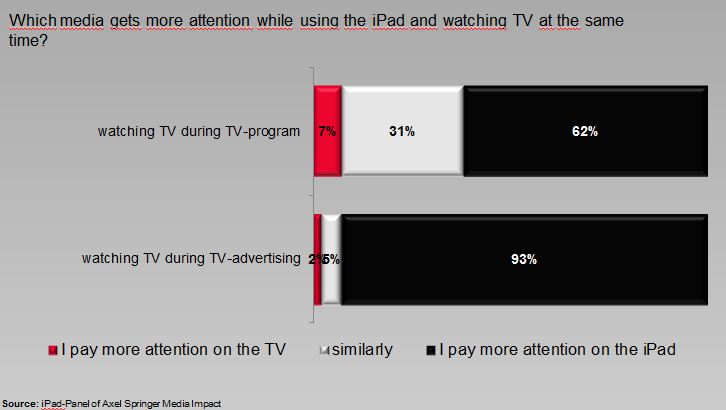
The tablet is also used while watching TV: 52% of the panelists often use their device during TV-advertising and 41% during TV-programs. Tablet users pay more attention to their gadget - even while watching a TV-program. A threat for TV-producers? Definitely, they have to transform this into an opportunity:

Click to enlarge pic

What's next? The Publisher has long-lasting plans with the iPad-Panel Media Impact:

- interviews will be enriched with technical measurements in apps
- the panel will be extended to Android users
- additional methods will be tested

It was interesting to have European research to 'confirm' findings from the US, for once. More findings and information {pdf}

Sunday, June 3

Taking Advantage of Editorial Credibility

During the FIPP Research Forum 2012, my Dutch colleague Ingrid van der Werf (Sanoma Media Netherlands) has shared interesting facts & figures on branded content in women's magazines. Thanks to recent quantitative and qualitative research (December 2011 - January 2012). There were three main purposes behind this initiative:
   - evaluate the effects of branded content on communication objectives
   - identify the conditions for effectiveness
   - determine criteria for successful branded content


She started with a definition that everyone can find on Wikipedia:
Branded content is a relatively new form of advertising medium (? euh) that blurs conventional distinctions between what constitutes advertising and what constitutes entertainment (true). Branded content is essentially a fusion of the two into one product intended to be distributed as entertainment content, albeit with a highly branded quality. 
And it works: advertorials in women's magazines are highly valued. According to readers, branded content "tells a different story than standard advertising" (quote qualitative research among 72 women aged 25-45). Therefore, it's not surprising that advertorials obtain a higher 'entertaining' score than classic ads (50% vs 36% - agree to: This page is made to entertain me - quantitative online research with dummy among 1200 women aged 25-45). 


When it comes to brand recall, advertorials obtain lower scores but that is compensate by higher scores for message recall: 44% for advertorials vs 33% for ads. The main objective(s) for using branded content in a nutshell: 
   - creating credibility
   - give more detailed product information
   - engaging readers


Challenge achieved for advertorials! As brand consideration scores are higher for branded content (50%) than for traditional ads (45%). Of course, both kind of advertising messages are mutually reinforcing each other. I'd like to end this summary by sharing 7 criteria for successful branded content in (women's) magazines:
    1. offer inspiration & tips
    2. give something to talk about
    3. complement editorial content (decode the codes of the magazine)
    4. be relevant (!)
    5. provide a fitting link with sender/brand (see point 3)
    6. be subtle about the benefits of the brand (readers know it's an ad)
    7. find a good balance between text and image


P.S.: Although branded content is not a new phenomenon in magazine advertising, the article on Wikipedia doesn't mention print at all! While there are great examples of successful advertorials in magazines. Print is definitely undervalued. But that was not the point of this blog post. However, if you want to know more about the do's and don'ts of branded pages in magazines, look at this great presentation with a lot of inspiration - by my colleagues at the Advertising Resource Centre (redirection on slideshare). 

Publishers' Reality Check and Call for Collaboration


Last Tuesday (29th May)  I went to London for my first  FIPP Research Forum (special thanks to my boss!). A two-day event for publishers, researchers and marketing executives in the magazine business. It's a huge opportunity to help improve magazine research around the world, to debate and compare learnings from each other's experience(s), to the benefit of all the industry. 

Unlike other conferences, the Research Forum encourages discussion and contributions from the floor with special sessions in breakout groups for delegate to debate the papers given in the previous session. Therefore, the number of delegates is set at a maximum of 50 in order to have restricted discussion groups with 12 to 14 delegates. Most of us agree this aspect of the Forum is/was the most valuable of the programme. 

The morning sessions of Day 2 (Wednesday) were dedicated to the digital and mobile developments in 'magazine land' with the focus on metrics and measurement techniques:

- The efficacy of Print + Web - Nicolas Cour (France)
- Consumers' use of talets, mobiles & other digital devices - Kathi Love (USA)
- Usage of and attitudes towards iPads: results from an iPad panel and How tablet in- advertising works - Anja Manouchehri (Germany)
- Measuring magazines' social media engagement, and building an overall engagement index John Carroll (UK)

When it was time to discuss these different studies in my breakout group, we looked at each other without enthusiasm. Because we felt there was more, an underlying question… Digital reading is (still) too small and publishers are losing feathers in the printed business model. The decline is not 'picked up' in digital reading. We have to face that we are becoming an industry in crisis. Without solutions in a short future, except trying new things and developments based (or not) on insights.  Don't get me wrong, we don't like short-termism but facts are facts. I can summarize our conversations in 3 key discussion points:

1. Do we really want the 'move' of our readers to digital? And more important: How do we 'keep' them in paper?

Duplication between print and digital is still very low. For magazines, it seems that digital is not (yet) the holy grail. We all agree it's necessary to create strong communities around our media brands. I have shared the example of the women weekly Libelle (Belgium) with a paid app dedicated to recipes called Libelle Lekker! together with the launch of a monthly about cooking with the same name. With some success.

My French colleague of Prisma Media, Nicolas Cour, cited the example of the TV guide Télé-Loisirs, that recently has launched an app - both on tablet and mobile - that makes it possible to program recordings with your device and out of home. Some services are paid and are satisfactory in term of profits. 

Egbert De Waal from South-Africa (Media 24) cited some nice examples of successfull cooking/fashion/specialized travel apps/mobile site with paid access to locally and 'internally' produced video content. 

But still, one big conclusion was: it's not enough to make profit, despite some successfull initiatives. In-app advertising and shopping can make a difference but we have not much understanding yet about this specific part of the business. It could mean an important charge for the short-term future in terms of development and the search of the right (commercial) partners.

2. To bundle or not to bundle? As magazine players tend to diversify in digital but also audiovisual media, it seems difficult to offer an advertising bundle that fits all the players of our industry.

To bundle or not to?
Are we sending the right signals to the market by acquiring other 'traditional' media active in the audiovisual sector or by investing a lot of money in digital companies and not in editorial? Where are these investments in print? 

Magazines are 'Pinteresting' avant la lettre, building strong readers' communities about specific AND general topics. We can show the market the engagement with traditional printed media is very high. But not seen as powerful enough. So, how can we convince readers and advertisers? 

Innovation is one key aspect. Flair Fashion Tag (Belgium) is a nice example: with this application readers can tag cloths and accessories in their Facebook friends’ photos. The tagged items are posted on the Fashion Tag wall and editors pick the best ones to publish in the magazine. Nice idea that improves the interactivity between the magazine brand and the readers and can result in commercial opportunities.


Finally, we ended this specific discussion topic with another important question: is bundling not dangerous in financial terms? Big (FMCG) companies are already claiming huge discounts when planning long-term campaigns. Is there a risk bundling will lead to discounts like never seen before? 

So, again the same conclusion: cross media strategies are not helping us at the moment. Soon, digital will become the next must-have in the media strategy together with TV. If the print industry don't act fast, it will lose the battle and will become 'nice to have but only when enough budget' for marketeers in charge of media strategies. 


3. Knowledge problem: digital people seem not interested in print. Therefore it's not a surprise they can't integrate print in a smart manner in the media plan.

People working in print and people in favor of printed media - dedicated planners and buyers in agencies included - seem to be better 'educated'. Digital players have little understanding of print in comparison to the digital knowledge of print players.


Conclusion:

So yes, we ended a little bit depressed. But not for long. Because we were able to face the truth and I'm sure it will lead to action and more collaboration. 

I would like to thank all the persons of breakout group B (see the list below) and Nancy Detrixhe in particular. Our dear chairman and reporter that has lent me her notes for this specific blog post. She's also doing a great job at the Dutch Publishers Association. Always posting new and relevant information about the power of print.


FIPP Research Forum 2012 - Breakout Group B delegates:

Anja Manoucherhi (Axel Springer), Henriette Mittag (Benjamin Media), Jean Faulkner (Conde Nast), Nancy Detrixhe (Dutch Publishers Association), Saara Itävuo (FPPA), Kathi Love (GfK MRI), Jane Farmery (Hearst Magazines UK), Georgy Mikaberidze (Hearst Shkulev Media), Egbert De Waal (Media 24), Nicolas Cour (Prisma Media), Peter Callius (TNS-Sifo) and myself (Sanoma Media)

Tuesday, April 24

She's a Reader

Yesterday was the yearly World Book Day. Time to celebrate the written word and to encourage our closed ones to discover/to share the pleasure of reading. I've found my own way to celebrate this day and I took the time yesterday to analyze the reading behavior of Belgian women. Because reading - books or other media - is a great way to escape our daily life!
Belgian women loves reading
View more PowerPoint from Vanessa Sanctorum

Source: research study #Femininsight - part of the project I'm every WOMAN-  some 3.000 Belgian women, aged between 15 and 75 years, were surveyed about their daily life (in February - May 2011)

Monday, April 2

Réflexions sur l'efficacité en 2012

La mesure de l'efficacité sous l'angle de la création et de la créativité des moyens étaient au centre de la journée annuelle de l'IREP consacrée à l'efficacité publicitaire. Un réel challenge. Car si la mission d'un média est d'exposer le consommateur au message, la réussite d'une campagne dépendra surtout de la création et des moyens mis en oeuvre. C'est également l''occasion de se rendre à Paris. Car j'admire l'art de la rhétorique de mes collègues français. Voici mes notes et réflexions personnelles sur les présentations qui ont su retenir toute mon attention:

L'émotion est au coeur du mystère

Je suis malheureusement arrivée à la fin de l'exposé de François Attali: " L'impact d'une communication repose d'abord sur des processus psychologiques".  Le temps de noter la conclusion: "L'émotion est le nerf de l'impact et de la valeur d'un produit". A la question : "OK. Mais le problème est que nous n'arrivons pas entièrement à identifier - dans la créa mais également en général - ce qui crée cette valeur émotionnelle?" La réponse fuse: "C'est tout à fait subsidiaire. C'est le produit qui doit être reconnu, pas la valeur émotionnelle de la création ou de la marque" Je ne peux qu'approuver. Car au final, on ne vend pas une création mais un produit, une marque, un univers, une solution,... Quitte à verser dans le sentimentalisme, je suis assez persuadée qu'il y aura toujours une part de mystère, c'est ça aussi la magie de la publicité.

De la persuasion à l'adhésion

Au centre de l'exposé de Nicolas Riou, l'importance des consumer insights ou 'l'identification de ce qui peut apporter un supplément d'être au consommateur', pour le citer.  Appréhender la vérité du point-de-vue du consommateur.  La garantie de ne pas développer une promesse à côté de la plaque. Afin d'illustrer son propos, rien de moins que des analyses de campagnes de communication efficaces, notamment celles primées au prix Effie. Inutile de préciser mon intérêt dans la question, au vu de mon implication dans l'étude #Femininsight de Sanoma Media.

Quels insights mettre en oeuvre lors de création et de planification de campagnes? 'Les méthodos classiques n'aboutissant que trop souvent à des caricatures dans la création de campagnes'. Dans son livre Marketing Anatomy, Nicolas Riou identifie 4 sortes d'insights:

  • les insights d'usage : une solution pour une insatisfaction/un besoin
  • les insights motivationnels : plus aspirationnels qu'utilitaires, liés aux valeurs socioculturelles 
  • les insights attitudinaux : liés à des opinions, des croyances, des valeurs plus individuelles
  • les insights psychologiques : le domaine de la construction et de l'affirmation de l'identité, la marque à le rôle d'une béquille identitaire 

L'identification de(s) l'insight(s) utile(s), le POWER INSIGHT, est d'une importance capitale dans le développement - créatif et stratégique - d'une marque. D'où l'importance des observations à domicile, le prolongement d'études de type consumer insights et l'identification des tendances socioculturelles. Car les tendances d'aujourd'hui sont peut-être au centre de comportement routinier de nos consommateurs (de) demain. 

(Quelques) Ingrédients pour une création efficace

Célia Gervaise et Coline Jubert de TNS Sofres ont partagé quelques enseignements sur la recette gagnante d'une création efficace en croisant des indicateurs d'efficacité de campagnes et des critères créatifs spécifiques (tels que la présence d'un jingle, l'utilisation d'un fil rouge, l'utilisation d'une double page, de l'humour, ... ). Exercice ô combien intéressant! A la différence des baromètres propres aux régies publicitaires, TNS Sofres a le luxe - ou le privilège - de disposer d'une base de données multimédias, avec l'ajout récent du digital (un petit 4% de la BDD).

Première conclusion: le score d'agrément (ou likeability) des campagnes est stable: de 76% en 2009, 79% en 2010 à 75% en 2011, pas de gros glissements. Une conclusion qui vaut également pour les annonces parues dans les magazines de Sanoma Media Belgium  et testées dans le baromètre stop/watch.

Bien sûr, le score d'agrément ne suffit pas à identifier l'impact d'une créa. Ou pour le dire autrement:  Si la création a un indice faible d'agrément cela constitue forcément un malus. Si la création plaît cela ne constitue pas forcément un bonus.  Mais la littérature sur le sujet a toujours démontré une forte corrélation entre le score d'agrément et le score de reconnaissance (recognition).  Et cela se confirme également au travers de l'analyse des campagnes multimédias repris dans les analyses de TNS Sofres. Une analyse sur les annonces du secteur automobile a démontré une forte corrélation entre le buzz (à parlé de la pub, s'est renseigné) et le score d'agrément.

Les critères créatifs influents sont-ils les même selon le média investigué, voir le dispositif média? Inutile de préciser que les créations démultipliées et les campagnes plurimédias ont plus la cote que les dispositifs isolés. Et force est de constater que certains médias se prêtent mieux à la diffusion de messages (plus) rationnels (l'internet, l'affichage et la presse). Ce qui m'a fort troublé c'est l'élément 'saga' qui revenait assez souvent pour la plupart des médias, internet n'étant pas inclus dans cette liste au contraire de la presse. Au travers de ces analyses 'rationnelles', ces deux dames ont, sans le vouloir, démontrées l'importance de l'entertainment et du storytelling en publicité.

La science cognitive au secours de la pub

Comment maîtriser la pub? Pourquoi la pub vend-elle? Bruno Poyet nous propose d'activer les bons processus mémoriels et émotionnels. Car rappelle-t-il, ce sont les souvenirs qui guident le comportement. Elle influe la perception, l'émotion et la raison.

'On choisit par l'émotion. On se rassure par la raison'

La méthode d'IM!Impact Mémoire analyse le projet de communication à travers 150 critères, traités par des évaluateurs qualifiés. L'outil se composant de grilles de questions fermées avec échelle d'intensité. Le message facilite-t-il la décision d'achat? Quelle est la force/la faiblesse du message? D'après l'annonceur présent, Laure Foullon - Marketing Efficiency Measurement Mgr de Coca-Cola - la méthode décrite offre de réelles pistes d'optimisation et prédit l'efficacité potentielle sur les ventes. 

En ce qui concerne Coca-cola, l'utilisation de cet outil a mené à la réallocation de certain budgets médias en fonctions des leviers créatifs de ceux-ci. Aux post-tests, l'annonceur préfère la mesure des leviers efficaces en création et l'identification de sous-objectifs menant à des ROI spécifiques (ROIM = ROI sur image; ROR = ROI sur recrutement, été) . Ce qui mène à des réels changements structurels au sein de la division française.

Un écran de télé à la verticale

Quel est l'impact de l'affichage numérique dans les gares parisiennes? Eric Merklen, Directeur Marketing de Mediatransports, nous livre quelques indicateurs grâce à une mesure barométrique mise en place à l'automne 2011 et portant sur une trentaine de campagnes.

L'affichage numérique plaît à un public jeune (18-34 ans) et même si les hommes semblent plus réceptifs, il interpelle un public mixte. Les voyageurs interrogés sur leur perception de ce média parlent de mini-film et d'écran de télé. Et ce sont bien les créations qui jouent la carte visuelle, plutôt que la carte de la lecture, qui atteignent les meilleurs scores. Il s'agit d'un mode d'expression définitivement plus créatif et narratif que l'affichage classique. 10 secondes sans bande-son pour interpeller le voyageur en mouvement.  

Conclusion

Des outils classiques tels que les baromètres d'impact, qui mesure la notoriété d'un visuel pendant et après la campagne, restent de bons indicateurs de l'efficacité d'une création mais ne suffisent pas à expliquer la réussite d'une campagne. Souvent parce qu'ils ne prennent pas en compte les (sous-) objectifs spécifiques d'une campagne. La journée sur l'efficacité de l'IREP aura démontré qu'il existe des moyens pour optimiser la création avant parution - grâce à l'identification de power insight(s) ou l'aide de la science cognitive.

Mesurer l'efficacité de la création publicitaire ne suffit pas: il faut également connaître les spécificités (des leviers d'efficacité) de chaque média pour pouvoir en profiter pleinement. En cela, on peut conclure que la publicité est réellement un métier où plusieurs disciplines se côtoient et s'enrichissent, que l'on soit 'créatif' ou 'analytique'. 

Sunday, February 26

20 Tweetable Truths about Belgian Women, Food and Media

Almost every day I fear this one question: what will I cook/eat this evening? First thing, I always ask my boyfriend. Most of the times, he struggles with the same lack of inspiration as I do. We both love food but not the preparation of the daily meal. So, I have to admit that I often turn to women's magazines to inspire me about recipes, and the French-written Belgian weekly Femmes d'Aujourd'hui in particular. And that's what inspire me to write this blog post:  What about Belgian women? How do they find inspiration? According to the research survey #Femininsight, 67% of the Belgian women mostly rely on magazines for (inspiration about) cooking recipes. The second preferred  information channel is very 'classic' too: culinary books (47%).

When it comes to food, drinks, restaurants or recipes, Belgian women turn to traditional information sources: brochures, the point of sales, magazines, TV,... I don't underestimate the power of digital media. As you will discover in the presentation below, e-newsletters and (traditional) websites are still powerful tools to inform  women. Social Media (Facebook, etc) are not very top of mind as preferred channel. Unfortunately, apps were not (yet) included in this edition.

In the presentation below, available for download on SlideShare, I've tried to compile information that can help marketeers in charge of food brands about the use of magazines in their media mix. Advertorials with recipes are great tools to integrate your brand in a non-intrusive way. Inspire women: 50% often tries a recipe after having seen it in a magazine and 48% follow tips read in culi editorials. Despite the huge amount of information available online, women cited magazines as the n°1 information sources about cooking recipes. Play that asset.

Monday, February 20

3 Must-Read about Pinterest

Guess what I'm talking about? Tip: Most of the site's users are female,with 97% of the site's  "likes"being made by women. Yep, I'm talking about the new social phenomenon:  Pinterest.

As a self-proclaimed marketing-to-women specialist, I couldn't ignore all the tweets and articles about the new trendy network. So, here's my latest 3 inspirational and informative sources I've read and saved in my documentation library :-)


- well-documented quick tour : principle, figures, inspiration about opportunities for business:

Pinterest for brands : opportunity or fad?
View more presentations from Emmanuel Vivier on slideshare

- 7 questions about the social platform in the article Know your Internet: What is Pinterest and why should I care? in the Atlantic.com

  • What is Pinterest?
  • Why should I care?
  • How does it works?
  • What do people post on Pinterest?
  • Who uses Pinterest?
  • Who is behind the new big thing?
  • Most important: How does it make money?

- Brands Pinning It on Pinterest on Adweek is about brands and my favourite domain: how can you be part of the game? That specific sentence makes me think about a lot of possibilities for a lot of brands:

“Your experts, your visionaries, your creatives now have this platform to syndicate content that is interesting to them, to help brands [tell their story],” Rachel Tipograph, social media director at The Gap

Branding is still an important part of our job as marketeers. So think about it. Pinterest is just another tool to play with in the new social game. 
.

Sunday, February 19

Internet Usage in Europe

comScore released an overview of internet usage in Europe, showing 381.5 million unique visitors went online in December 2011 for an average of 27.5 hours per person. Internet users in Belgium now dedicate over 20 hours to the web a month. This is far below my weekly consumption :-)
Source: comScore Press Release 16/02/2012

Sunday, October 23

10 Tweetable Truths about Women and Social Networks

I've already talked (written) about the research study #Femininsight - part of the project I'm every WOMAN-  some 3.000 Belgian women, aged between 15 and 75 years, were surveyed about their daily life (in February - May 2011). Besides sector-related information, we, marketeers at Sanoma Media Belgium, were also curious about the media consumption and media behavior of Belgian ladies. 

My colleagues Trui Lanckriet and Marie Carranza were guest speakers at the last Media Session at the GRP about the evolution of media habits in Belgium. Their presentation will be available soon on the official website of the media sales house of Sanoma Media Belgium. I was really inspired by their presentation and wanted to add my personal touch to their analysis. So, I've focused on the use of social networks by Belgian women. THE HOT TOPIC nowadays.

With only 4% of Belgian women sharing information through blogs and fora - 2% on social networks - the easiest conclusion should be: Belgian women don't care. But that's just one side of the medal. Belgian women are digital ladies: 35% visits social networks daily and women with a profile on facebook even more: 22% checks it more than once a day. And nearly 1 out of  5 agrees with the fact that Internet helps to avoid ‘bad buys’. Discover more about Belgian women and social networks in the presentation below. Feel free to share and to spread the word. As usual, you can download this presentation on SlideShare .
The audience I try to reach through my blog is made out of people with a busy agenda. That's why I like the difficult exercise to put information in so-called Tweetable Truths, summarizing facts and figures in less than 140 characters. Right now, I'm just wondering about the ideal numbers of slides/truths. I guess, somewhere between 20 and 50. Let me know if I'm right. 

Sunday, October 16

Our iPad Not Mine

From early July to the beginning of August 2011, Sanoma Media conducted an iPad survey in 6 European countries in which it is active and distributes apps: the Netherlands, Finland, Russia, Hungary, Belgium and Germany. Via banners in various Sanoma apps, a total of 3,673 respondents were asked about their use and experience of working with this famous tablet.

Not a personal toy
The iPad has become the primary device at home and the preferred tool to access the internet. But it's by no means a personal computer: 67% of the iPads are actively used by other persons. This is usually the partner and, in over a third of cases, the children.

Click on pic to enlarge


She plays, he surfs
Traditional surfing behavior still rules, even with an iPad. It is used mainly for reading the news, surfing and browsing, searching and e-mailing. A second category includes social networking/blogging, playing games, reading magazines, watching TV and videos and looking at photos. Women play more games than men. Shopping, comparing and internet banking are less frequent activities.

On the couch, in bed and at the breakfast table
The iPad is a companion for the evenings in the living room (83%) and for reading the news in the morning (70%) at the breakfast table. But it's also ideal for a last 'social media' check in bed before going to sleep (67%).

Click on pic to enlarge
More info and another nice infographic with socio-demographics available here . Some specific information on Belgium coming soon.

50 Tweetable Truths about Women in Belgium

It's been a while since my last blog post. September is usually a tough month with the release of the Print Audience Study (always on September 15th). But this year was particular: besides analysis on the evolution of the Print Audience Study, I have this other beautiful and interesting project at work: the project I'm every WOMAN with the announcement and launch of #Femininsight .

#Femininsight is so much more than another quantitative research. Some 3.000 Belgian women, aged between 15 and 75 years, were surveyed about their daily life and media consumption behavior (in February - May 2011). Enriched with facts and figures about beauty, fashion and food. But the cherry on the cake - in my point of view - is the specific typology that describes 6 different types of women. It's a powerful and inspirational tool for marketeers and creative people.

You could probably write a book with all the information included in this research. But I've started with a PowerPoint presentation. But one with a feminine - practical- and viral touch; summarizing more than 50 facts and figures about women's daily life in less than 140 characters.

My specific task on this project is to feed @iewoman and monitor this account. I will also regularly add new information through this blog and the corporate website of the media sales house of Sanoma Media Belgium, my employer. Enjoy and don't hesitate to spread the word :-)

Sunday, September 18

Belgians Still in Love with Magazines

Personal message to marketeers and media specialists: as you may have seen in specialized shops, printed media are still alive. That's because they are still relevant to a lot of different people. Not only to the old grumpy retiree or the discount hunter in search of good deals in local free sheets.

With 9 out of 10 reading one I dare to say Belgians are still in love with magazines. Take a look at the presentation below. It contains the latest audience figures of printed media in Belgium (based on annual CIM Audience Study - release 15th September 2011). 

Monday, July 25

Which Media Diet for Light TV Viewers?

(FMCG) Advertisers continue to spend large amounts on expensive TV campaigns. The (long time ago) announced death of the TV-spot is still not a reality. On the contrary! Honestly I'm wondering why, knowing that 4 out of 10 Belgians are light TV viewers. My gut feeling says that these people don't like pushy TV ads. Unfortunately, the CIM-PMPA*-study - which contains data about media audiences and frequency of usage - doesn't measure advertising likeability. But it defintely can help you in your media choice with specific analysis on light and non TV viewers.

Why would advertisers be interested in reaching light and non TV viewers? According to an analysis I've made on the CIM-PMPA, this category represents 3.700.000 people in Belgium (over 12 years old). Not a minority. More than half are the ones in charge of picking up the groceries (the so-called Main Responsible for Purchases). My 'investigations' also demonstrate that light viewers have a more attractive demographic profile: 37% of them are classified in the highest socio-economic groups (1-2)  and 36% are highly educated. It's also a very gender-balanced profile with 51% women. So don't make the wrong match:
LIGHT or NON TV USER =  
MAN or CHILD PLAYING with a MOBILE/COMPUTERLIKE THING
Talking about segmentation, it seems that cultural differences don't play a big role in the media behavior. But gender does. It was really not a surprise to me that women tend to be more print-minded and heavy users of magazines (both weeklies and monthlies). Men seem to appreciate internet and the seats (or popcorn?) of movie theatres more.

Female light viewers represent 20% of the Belgian population. As an employee of Sanoma Media Belgium, with a women-oriented portfolio, I have a strong interest in the media behavior of this target.The CIM-PMPA study gives me insight into the reach and the coverage of magazines in general and of our titles specifically. The most important findings are summarized in a presentation below. As usual, you can download this material for free on SlideShare, with speaker notes for the most difficult slides :-) If you like it, feel free to share.
Even with its limitations, the CIM-PMPA survey is a wonderful tool. All the (most important) media brands with a 'Belgian' ratecard are taken into account. It has one handicap: it doesn't measure (big) foreign channels/titles and of course, non-subscribers. That could be a little bit tricky, especially when 'measuring' the 'real' impact (reach) of TV and some radio channels in the south of the country. Why? It's commonly known that a lot of French-speaking Belgians turn to French TV-shows for entertainment. Each survey has limitations. This is one of them. It's not the Holy Grail. But even if it only gives us an indication of each medium, it's still a valuable tool with a qualitative and quantitative sample. 


*CIM- Center for Information about Media in Belgium
  PMPA: Pluri-Media/Products/Attitudes

Thursday, June 16

5 Must-Read about Magazines

I like to think that my blog is a kind of logbook where I can post my thoughts on things I have read. An open archive. This week I've read a lot of interesting stuff about magazines - printed and digital - and I thought it would be a nice idea to make a selection. I can't promise this post is the start of a serie. It will depend on what I've spotted online. This week: a healthy mix of research and creativity.

Print is NOT dead - Marketing Mag
Recent proof that magazines can optimise advertising effects. Or when neuroscience proves that placing an ad in a magazine not only helps consumers gain brand retention, but also adds positive brand salience for your brand.

Digital Subscriptions Will Lift Magazines But Not NewspapersJeff Bercovici's blog on Forbes.com
Over the next five years, both magazines and newspapers will enjoy large gains in paid digital circulation, PwC forecasts. But the revenue generated will grow far faster for magazines than it will for newspapers.

25 Creative Use of Magazines - Magazinespunt.nl on SlideShare
Magazinespunt.nl has made several ppt with examples of creative advertising in magazines. Each presentation focuses on another sense. This one contains treats for the eyes (Sight is the sense in the picture in this chapter). Enjoy!

Apple iPad usage habits {INFOGRAPHIC} - The Telegraph
In May 2011, app specialist imano conducted a survey among 2008 iPad users in the UK. The findings were highlighted in an infographic. Some 69% use their device to read newspapers and/or magazines. Learn more about their usage and behavior.

Shieldtox: Natural Protection - CreativeCriminals
Click to see greater format
An insecticide is not a very sexy product to advertise. But creativity is the most important key. Euro RSCG Bangkok has done a great job for Shieldtox, a natural insecticide. The central idea: natural predators. Spotted by the CreativeCriminals, 3 guys of the advertising world that present each day a selection of the most creative ads from around the globe. Click on link for another campaign visual.

Saturday, June 4

La Nouvelle Ménagère: un homme comme les autres?

Cette sacrée ménagère. Objet de toutes les attentions. Pour preuve, un des derniers Lunch BMMA avait pour thématique "Il ne faut pas la lui faire à la nouvelle ménagère", avec Marc Vandercammen du CRIOC (Centre de Recherches et d'Information des Organisations de Consommateurs). J'avoue: je n'y étais pas. Pour toute consolation: ne pas devoir entendre la notion nouvelle ménagère 150 fois en moins d'une heure.

Pour le coup, j'ai une nette préférence pour le terme PRA (principal responsable des achats) quand on parle d'achats d'ordre domestique, et de principal responsable pour la préparation des repas chauds ou du choix des marques dans un domaine particulier. Ce n'est pas pour rien que le Centre d'Information sur les Médias (CIM) fait la distinction. Et c'est nettement moins sexiste. De plus, ça pourrait peut-être contribuer à faire évoluer les mentalités de ces messieurs :-)

J'entrevois déjà le lever de boucliers! Malgré l'avènement de l'homme aux fourneaux, c'est encore madame qui range, qui nettoie le plan de travail et qui décide principalement des marques et aliments qui sont servis à table. Principale conclusion à tirer: la nouvelle ménagère a pour principal défaut de ne pas assez imposer la contribution des autres membres du ménage quand il s'agit des corvées domestiques. Plusieurs études, dont l'étude CIM-PMPA (pour volet Plurimédia-Produits-Attitudes), démontrent que les femmes sont toujours  n°1 lorsqu'il s'agit de cibler les décideurs de (marques de) produits ménagers. Exit le nouvel homme?
Honnêtement, je me demande encore qui ça peut étonner. Mais alors, pourquoi certains annonceurs utilisent des voix masculines et/ou acteurs pour nous vendre leur marque? Pourquoi ce genre de spots/pubs existent-ils encore et jouent-ils sur des clichés où l'expert est masculin? Pensez-y à deux fois lors de la conception de vos campagnes.

Dans une prochaine analyse: les enfants et les proches, quelle influence pour les marques de grande distribution? Timing prévu: fin du mois de juin.

Wednesday, March 23

App Store Stats

Sometimes I wonder how many apps are submitted per day to the iTunes App Store... If you struggle with the same question or if you're curious about the average app price, take a look at the App Store Metrics Page. This page was originally created to celebrate the App Store reaching 10,000 apps.


By the way, the editorial team of 148Apps.biz seems eager to hear our feedback.